
Not many travelers from outside of Europe make to it to this tiny country, the last Grand Duchy left in the world! One of the smallest -but also richest- countries in the world, with three official languages, vineyards, castles, medieval villages, canyons and founder member of the European union: Luxembourg!

Let’s be honest.
It’s hard for such a small country between the tourist destination giants like France, Germany, the Netherlands and Belgium. Most people will visit Paris, London, Berlin, Bruges and Amsterdam, but miss out on the unique capital Luxembourg city. Most people book a cruise on the Rhine or the Moselle, and you won’t make it up to Luxembourg. If there’s one thing I learned through all my travels (76 countries and counting..) it’s this:
.
The harder it is to reach a destination, the more rewarding the visit is going to be.
It’s like a cold beverage after a hard day of work, the reward is more intense, you’ve invested time, energy and effort into reaching it and now you’re going to enjoy it too!
Europeans use Luxembourg as a cheap way to buy gas, alcohol and for some, tobacco on their way going either north, or south. Luxembourg has a tax exempt on any of these products, making a stop in Luxembourg worth your while. Whenever I’d go on a holiday to the Alps or to the Mediterranean, a stop in Luxembourg was a mandatory included stop for gas. However, Luxembourg has so much more to offer!
Top Destination
Whether you seek culture, nature, history, or culinary delights, Luxembourg offers it all within a compact area. Stunning wine regions that can compete with Portugal’s Douro Valley, the charming village of Esch-sur-Sûre, and the country is home to over 100 castles! Luxembourg City Airport connects with major European hubs such as Amsterdam, London, Paris, and Frankfurt. If you’re traveling from North America, it’s likely you’ll transit through one of these cities. A notable advantage of this country is that all public transportation is free. The longest journey from north to south spans 130 km (81 miles). Despite being landlocked, Luxembourg features an impressively varied landscape.
The only left Grand Duchy in the world: a short history
The Dukes of Luxembourg have strong family ties to the Royal Family of the Netherlands, the house of Orange-Nassau, and a bit further away with the royal family of Belgium too. The history of Luxembourg is layered and is influenced by German, French and Dutch history. Yet the country has it’s own distinct Luxembourgish culture. Think of the local dishes Judd mat Gaardebounen, Riesling pâté andQuetschentaart.
Since 1354 the emperor Charles IV elevated the county of Luxembourg to the Duchy of Luxembourg. This gave the Duchy great liberty within it’s borders and has managed to maintain it’s independence mostly due to it’s position between the two larger brothers Germany and France.
It was after the Congress of Vienna (1815) that the Grand-Duchy of Luxembourg was established. The European Powers created the Kingdom of the Netherlands, of which Luxembourg and Belgium were a part too. The Benelux countries formed one country not for long however. In 1830 the Belgian elites started to revolt against King William the I, from the house of Orange, which had it’s powerbase in the Northern Netherlands and whom resided in the Hague.
Belgian independence was reached within the same year, however Luxembourg remained part of the Kingdom of the Netherlands till 1890. Meaning King William the I, and his heirs William II and William III, were also recognized as the heads of state, or Grand dukes of Luxembourg.
In 1890 the heir to King WIlliam III was a lady, and according to the salic law in Luxembourg, a female heir could not inherit the title of Grand Duke. However the Dutch and Luxembourgish royals still enjoy warm ties today, since the throne in Luxembourg was given to a male cousin of the House of Orange Nassau. The Grand Ducal family of Luxembourg today descends from the House of Nassau which is the same broader lineage of the House of Orange-Nassau. Before playing the national anthem, the Luxembourgish play an instrumental version of the ‘Wilhelmus’, the national anthem of the Netherlands to emphasize the relationship with the Netherlands.
Luxembourg may be small, but it has played an outsized role in European politics. As one of the founding members of the European Coal and Steel Community—the seed of today’s European Union—it helped shape the continent’s post-war cooperation. Luxembourg City now hosts several major EU institutions, including the European Court of Justice, the European Investment Bank, and parts of the European Parliament, giving the country an influence far beyond its size. Its long tradition of political stability and multilingual culture make Luxembourg a natural hub for European diplomacy and decision-making.
The Valley of the Seven Castles
The valley of the seven castles rings like you want to visit it, right?
The Valley of the Seven Castles (Guttland – Dall vun de siwe Schlässer ) is one of Luxembourg’s most scenic cultural landscapes, running roughly 24 km between Mersch and Koerich, just west of Luxembourg City. It follows the gentle Eisch Valley, where a chain of medieval fortresses once controlled trade routes and territorial borders. The seven castles are:
Mersch – Schoenfels – Hollenfels – Ansembourg (Old & New) – Septfontaines – Koerich
What makes the valley special is not just the castles themselves, but their setting: rolling farmland, forested hills, small rivers, and quiet villages—very different from the dramatic Ardennes in the north. Several castles can still be visited, notably Hollenfels, Schoenfels, and Koerich, while others are private but beautifully visible from the road or walking trails.
Historically, the valley reflects Luxembourg’s role as a feudal buffer zone between larger powers (Burgundy, the Holy Roman Empire, France). Today it’s ideal for slow travel: short walks, cycling, castle-hopping by car, and combining history with local food and wine.
For visitors, it’s a perfect half-day or day trip from Luxembourg City—quiet, green, and deeply rooted in medieval Luxembourg, without the crowds.
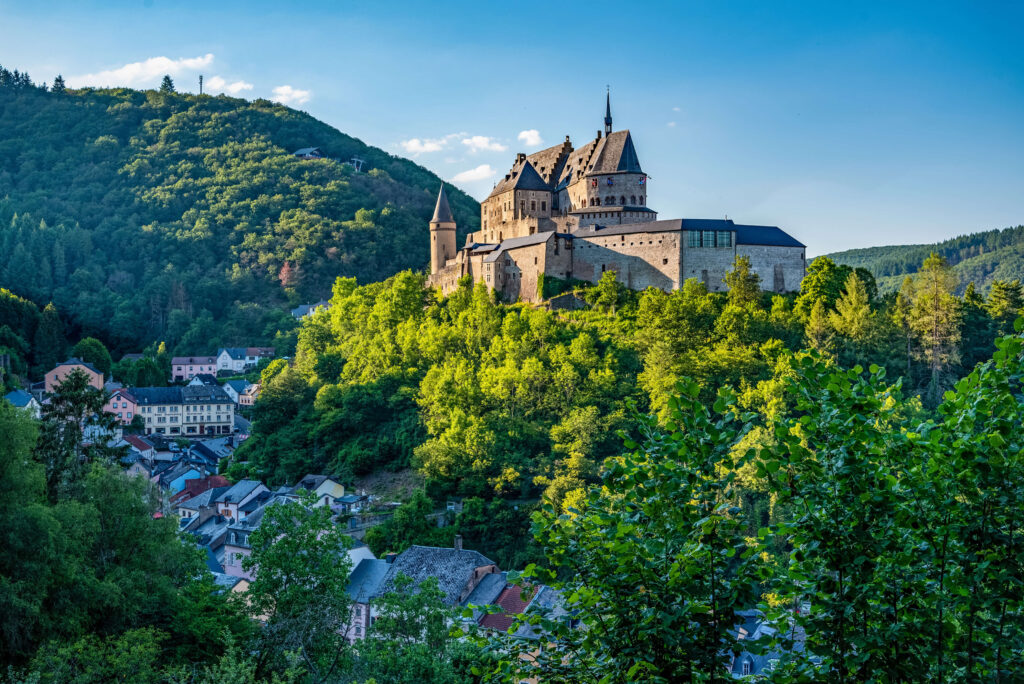
Vianden Castle
Luxembourg’s grander castles are however, not in the valley of the seven castles. There’s the three big ones, Vianden, Bourscheid & Beaufort Castles, all three making children’s fantasies come alive. Bourscheid castle is beautiful, and is only a 45 minute drive from Vianden castle. Beaufort castle is a romantic place, although the castle is for the large part, in ruins.
Vianden Castle (Château de Vianden) is Luxembourg’s most iconic medieval fortress, dramatically rising above the town of Vianden in the Our Valley near the German border. Built between the 11th and 14th centuries on Roman and Carolingian foundations, the castle reflects both Romanesque solidity and Gothic elegance, mirroring the power and prestige of the Counts of Vianden, one of the region’s most influential noble families.
Abandoned after the 18th century, the castle fell into ruin before being meticulously restored in the 20th century—most notably under the patronage of Grand Duke Jean of Luxembourg, who later donated it to the state. Today, Vianden Castle stands as a symbol of national heritage, offering richly furnished halls, chapels, and towers, along with sweeping views over the forested valley below.
Easily accessible yet impressively commanding, Vianden Castle is widely regarded as one of the finest feudal castles in Europe and a highlight of any journey through northern Luxembourg.
When asked “What’s your favorite castle in Luxembourg?” A local Luxembourger will likely answer:
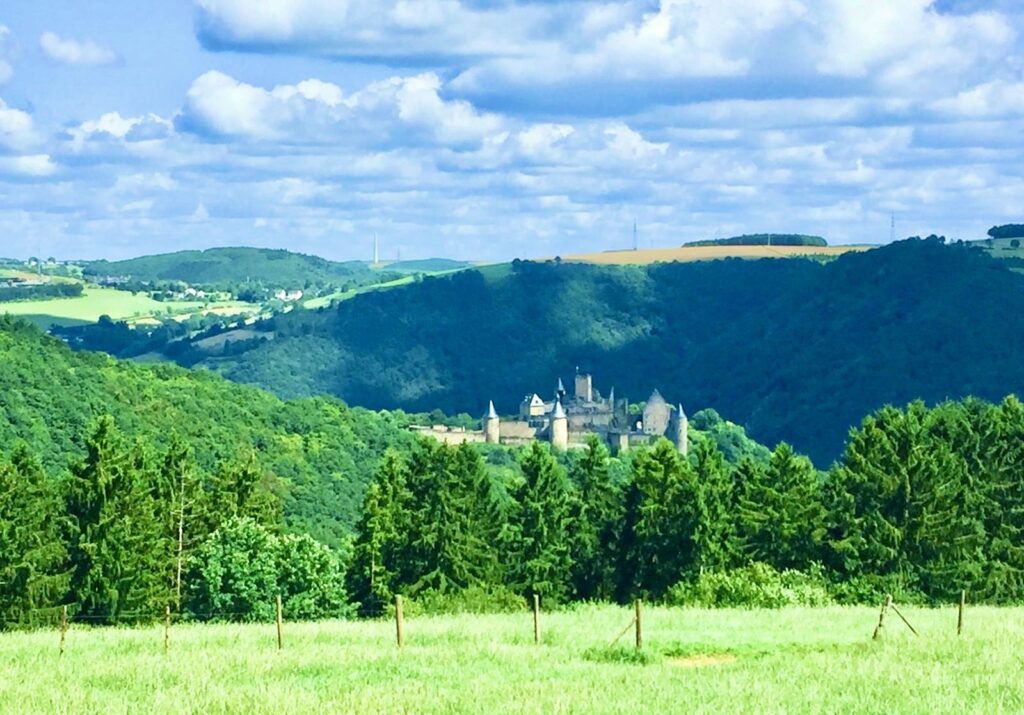
Bourscheid Castle
Perched high above a sweeping bend of the Sûre River, Bourscheid Castle is one of Luxembourg’s most spectacular medieval fortresses. Founded around the year 1000, the castle dominates the surrounding Ardennes landscape with its massive stone walls and commanding views over deep forests and valleys. Expanded over several centuries, it evolved into a powerful defensive stronghold, complete with thick ramparts, watchtowers, and an inner courtyard that reflects the layered history of feudal Luxembourg.
Today, Bourscheid Castle is beautifully restored and open to visitors, offering a rare chance to walk along its battlements and towers while taking in some of the finest panoramic views in the country. Especially at sunset, the castle feels almost timeless, suspended between history and nature. It is a highlight of northern Luxembourg and a key stop for anyone wanting to understand the region’s medieval power structures, strategic geography, and enduring sense of place.
Luxembourg City
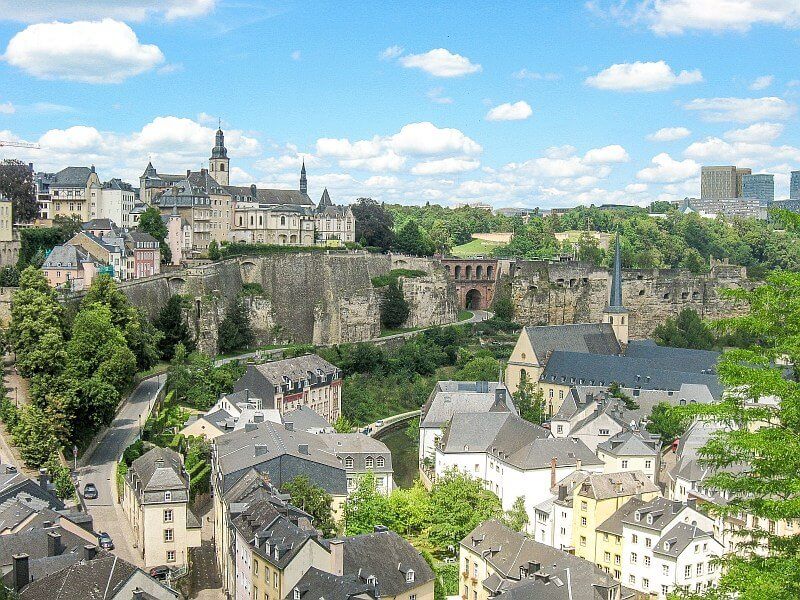
Luxembourg City is a small but remarkably layered European capital, uniquely shaped by its geography and history. Built atop dramatic sandstone cliffs at the confluence of the Alzette and Pétrusse rivers, the city developed as a fortress capital—so formidable it earned the nickname “Gibraltar of the North.”
For centuries, Luxembourg City sat at the crossroads of Europe’s great powers—Spanish, Burgundian, Austrian, French, and Prussian—each leaving traces in its fortifications, casemates, and urban layout. Today, the old town and fortifications are a UNESCO World Heritage Site, where medieval streets, Renaissance buildings, and Vauban-era defenses coexist within walking distance.
Modern Luxembourg City is also a global financial and European political hub, hosting major EU institutions alongside historic quarters like the Grund and Clausen, set in the valleys below the city center, which are easily reachable with a great variety of cable cars and lifts. One of its quiet innovations: all public transport is free nationwide, making the city unusually easy to explore.
Compact, green, multilingual, and outward-looking, Luxembourg City blends history with modern European life—a capital best discovered on foot, where dramatic viewpoints and intimate neighborhoods reward slow exploration.
The wine valleys
Luxembourg has only one wine region, the Moselle Valley, which is simply breathtaking. In my opinion, both the Douro Valley in Portugal and Luxembourg’s Moselle Valley rank among the most beautiful wine river valleys in Europe. The name “Moselle” comes from its Latin origin, “Mosella,” meaning ‘little Meuse,’ named after a larger nearby river that flows to Rotterdam in the Netherlands. The Moselle is one of the Rhine’s major tributaries. It is referred to as Moselle in English and French, Mosel in German, Musel in Luxembourgish, and Moezel in Dutch.
The Moselle River serves as a natural border between Germany and Luxembourg, with Luxembourg benefiting from sunny south-facing slopes that receive abundant sunlight.
The Luxembourg Wine Valley runs along the Moselle River, creating the country’s sunniest and most refined scenery. Over approximately 40 kilometers, vineyards ascend gently rolling hills above the river, interspersed with delightful wine villages such as Remich, Wormeldange, Grevenmacher, and Ahn.
The region is best known for its crisp white wines and sparkling Crémant de Luxembourg, produced mainly from grapes like Riesling, Pinot Gris, Auxerrois, and Elbling. Thanks to the Moselle’s reflective light and mild microclimate, the wines are fresh, mineral, and refined—often compared to those of neighboring Germany and Alsace, but with a distinct Luxembourg character.
What makes the wine valley special for visitors is its relaxed, accessible atmosphere. Vineyards, river promenades, cycling paths, and tasting rooms lie close together, making it ideal for slow travel. Many family-run wineries welcome visitors directly, and the landscape lends itself beautifully to gentle walks, bike rides, and long lunches overlooking the river.
The village of Schengen, nestled along the Moselle, in southeastern Luxembourg, is best known as the birthplace of the Schengen Agreement, which reshaped Europe by removing internal border controls. Signed here in 1985 aboard a ship on the river, the agreement made Schengen a symbol of European cooperation and freedom of movement. Today, the village combines quiet wine-growing charm with outsized historical significance at the crossroads of Luxembourg, France, and Germany.
Compact, picturesque, and largely undiscovered, the Luxembourg Wine Valley combines excellent wines, scenic beauty and nature—a perfect contrast to the country’s castles and historic cities.

The walks: Litte Switzerland – The Müllerthal region
Little Switzerland in Luxembourg refers to the Müllerthal Region (Mëllerdall), in the east of the country near Echternach. The nickname comes from its surprisingly rugged landscape rather than any alpine height.
The area is shaped by millions of years of erosion in soft sandstone, creating narrow gorges, moss-covered rock walls, caves, and winding streams. This gives the region an almost fairy-tale feel, very different from the open farmland of central Luxembourg or the forested Ardennes in the north.
Little Switzerland is best known for the Mullerthal Trail, a network of well-marked hiking routes that pass through dramatic formations such as the Wolfsschlucht, Berdorf plateau, and the iconic Schiessentümpel waterfall with its small stone bridges. Despite its wild appearance, distances are short and paths are accessible to casual walkers as well as experienced hikers.
What makes the region special is its quiet intimacy: shaded forests, rock passages you can walk through, and small villages that feel far removed from big-city Europe—yet it’s only about 40 minutes from Luxembourg City. It’s one of the country’s most distinctive landscapes and a highlight for travelers seeking nature, walking, and slow exploration.

World War II & Battle of the Ardennes
The Battle of the Ardennes—known in the U.S. as the Battle of the Bulge—had a profound impact on Luxembourg, especially in the winter of 1944–1945. When German forces launched their surprise offensive in December 1944, northern Luxembourg was among the first areas hit, with fierce fighting around Clervaux, Wiltz, Diekirch, and Ettelbruck. The town of Clervaux was nearly destroyed, becoming one of the most symbolic battle sites in the country. The town of Clervaux is worth visiting, since Clervaux castle is one of the oldest in Luxembourg.
Luxembourgish civilians were caught directly in the conflict, facing evacuations, destruction, and shortages during one of the harshest winters of the war. Allied resistance and eventual counterattacks pushed German forces back by January 1945, leading to the final liberation of Luxembourg. Today, the battle is remembered through memorials, military cemeteries, and museums—most notably in Clervaux and Diekirch—which preserve Luxembourg’s central role in this decisive moment of World War II history.
The Liberty Road is a marked WWII remembrance route that traces the advance of Allied—mainly U.S.—forces during the liberation of Luxembourg in 1944–1945. It runs from the southern border northward through towns such as Schengen, Luxembourg City, Ettelbruck, Diekirch, and Clervaux, marked by distinctive red-white-blue “L” signs. Along the route you’ll find memorials, cemeteries, and museums that tell the story of liberation and the Battle of the Bulge, making it both a scenic drive and a powerful historical journey.
Perfect for day trips
Luxembourg is one of Europe’s most rewarding gems: a compact country where medieval castles crown river valleys, dramatic cliffs frame a UNESCO-listed capital, and nature is never far away. In a single journey you can explore storybook fortresses like Vianden, walk through the rock gorges of “Little Switzerland,” and enjoy refined food and wine in quiet villages—all without crowds. Easy to reach, beautifully preserved, and effortlessly calm, Luxembourg offers rich history, striking landscapes, and slow, elegant travel at the very heart of Europe. You won’t regret visiting Luxembourg!
Dutch Cultural Journeys loves this country and we are happy to help you arrange transportation, find the best places for unique stays, or the best restaurants. In nature or in castles, or in the city of Luxembourg.
For more on the Benelux region, Belgium, the Netherlands & Luxembourg, check out the rest of my blog here.
Written by Ralph Deckers
Guide & Historian – Dutch Cultural Journeys